Category: Puritan Works (Page 3 of 8)

Bite-Sized Belief: Why You Need Joseph Alleine’s A Most Familiar Explanation of the Assembly’s Shorter Catechism

Have you ever sat down with the Westminster Shorter Catechism and felt like you were staring at a brick wall of dense theology? You know the truths are vital, and as a parent or a church member, you want to internalize them, but the language can feel heavy. You want to lead your family in the “right path,” yet you struggle to explain what “effectual calling” or “justification” actually looks like on a Tuesday morning. Joseph Alleine, a 17th-century pastor with a heart for his people, noticed the same problem. In his work, A Most Familiar Explanation of the Assembly’s Shorter Catechism, he takes the grand architecture of our faith and breaks it down into “lesser parcels” so the light can get in.

Your home is meant to be a mini-cathedral

One of the most striking things Alleine emphasizes is that the primary responsibility for Christian education does not lie solely with the pastor on Sundays. He argues that householders have a “great responsibility” to teach those under their roof. In a world where we often outsource our children’s spiritual growth to apps or youth groups, Alleine calls us back to the family altar. He believes that every home should be a “Christian church” and a “house of prayer.”

This is not just about being a strict teacher. For Alleine, family godliness is about the “weighty charge of immortal souls.” He treats the home as a nursery for the kingdom of God. If the home is spiritually cold, the church will eventually feel the frost. By breaking the catechism into smaller questions, he makes the daunting task of family worship feel possible for the average person.

Let every family in your midst be a Christian church, every house a house of prayer, and every household a household of faith.

There is a dangerous difference between “knowing” and “knowing”

Alleine draws a sharp line between two types of knowledge: confused and distinct. He observes that many churchgoers have a “confused knowledge”—they know a concept exists, but they cannot explain what it is. They might use the word “grace,” but they couldn’t describe it if their life depended on it. On the other hand, “distinct knowledge” involves understanding the essence of a concept and knowing the scriptural grounds for believing it.

As a pastor, this hits home. It is easy to assume that because we hear the words every week, we actually understand them. Alleine warns that this lack of clarity stems from a “lack of humility and diligence.” He challenges us to move past vague religious feelings and toward a “sound account” of our faith. This isn’t just academic; it is about having a clear sight of Christ.

Confused knowledge merely acknowledges the existence of something without understanding its essence. . . . Distinct knowledge, on the other hand, involves comprehending the essence of a concept.

Conversion is a total makeover, not a paint job

When Alleine explains the “effective calling” mentioned in the Shorter Catechism, he shows us that the Holy Spirit does more than just give us a little help. He describes it as a work where the Spirit convicts us of misery, enlightens our minds, and actually “renews our wills.” He is very clear that we are naturally “as unwilling as we are unable” to embrace Jesus Christ on our own.

This takeaway is impactful because it reminds us of our total dependence on God’s power. We don’t just need better information; we need a new inclination. The Spirit makes us love the good we used to hate and hate the evil we used to love. This radical change is the only way a person moves from being “civilized” to being “sanctified.”

Are there new inclinations in the wills of those who are effectually called, so that they love the good they previously hated and hate the evil they previously loved? Yes.

Prayer is a heart-offering, not just a word-recital

In his breakdown of the Lord’s Prayer and the nature of petition, Alleine offers a necessary rebuke to our formal habits. He defines prayer as “offering our desires to God.” He asks a piercing question: is it actually prayer if we just repeat “lifeless words” without our hearts being involved?

This reminds us that God is looking for the “offering of our hearts.” Whether we are using a form like the Lord’s Prayer or speaking from the moment, the essence of the duty is the desire of the soul. He also points out that we must find our encouragement in prayer “solely from God” and not from our own worthiness. This shifts the focus from our performance to God’s sovereign power and fatherly willingness to help.

Is it considered prayer if we repeat a few lifeless words without offering our hearts and desires? No.

Self-examination is the daily medicine we often skip

At the end of the book, Alleine provides a list of questions for daily self-reflection that act as a spiritual health check. He doesn’t want us to wait until the Lord’s Supper to examine our hearts. He suggests we ask ourselves things like, “Did I not find myself on my bed when God was looking for me on my knees?” or “Have I spoke any lies in my business or trade?”

This is incredibly practical for the laity. It bridges the gap between high doctrine and the “business or trade” of our daily lives. It forces us to see if our “personal godliness” is actually affecting our tongue, our table manners, and our time management. For Alleine, a soul that doesn’t examine itself is a soul that isn’t making progress in holiness.

Why you should read this book

You should read A Most Familiar Explanation of the Assembly’s Shorter Catechism because it turns the “foundational principles of religion” into something you can actually talk about over dinner. Joseph Alleine writes with the urgency of a “messenger of Christ” and the tenderness of a father. If you feel like your spiritual knowledge is “confused” or your family worship has become a “hollow and lifeless profession,” this book is the guide you need. It doesn’t just explain the truth; it “lets in the light” so that you can truly enjoy God forever.
The Jailhouse Joyride: How Joseph Alleine’s The Saint’s Pocket-Book Proves You Are Richer Than You Think

We have all had those mornings where the weight of life feels like a heavy blanket we cannot throw off. Maybe it is the bank account, a nagging health issue, or that quiet, persistent voice of the accuser reminding you of yesterday’s failures. We often look for a quick fix or a motivational quote to get us through. But what if the answer was written by a man sitting in a cold, cramped prison cell in 1666? Joseph Alleine was a man who lost his physical freedom for the sake of the gospel, yet he wrote as if he owned the world. In his classic work, The Saint’s Pocket-Book, Alleine reminds us that if we are in Christ, we are not just surviving; we are spiritual millionaires. As a pastor who leans daily on the truths of our confession, I found this book to be a necessary jolt to the soul.

The Covenant is your legal deed to the universe

One of the most striking things Alleine does is use the language of the courtroom and the counting house to describe our relationship with God. He does not just talk about vague feelings of love. Instead, he presents the Covenant of Grace as a formal, legal “instrument of salvation.” He describes it as a deed that has been signed, sealed, and delivered by God Himself. This is deeply impactful because it moves our assurance away from our shifting emotions and onto the unchangeable “act and deed” of God.

For the believer, this means your inheritance is not a “maybe.” It is a settled matter. Alleine portrays God as a Father who has legally bound Himself to His children. This provides a rock-solid foundation for the weary Christian. When you feel like you do not belong to God, you can point to the “sacred blood” that ratified the contract.

Look, I make an everlasting covenant with you, ordered in all things, and sure; and I hereby solemnly deliver it to you as my act and deed, sealed with sacred blood, and ratified with the oath of a God.

God gives you His person, not just His things

It is easy to fall into the trap of treating God like a vending machine—we go to Him for peace, for help, or for stuff. But Alleine brilliantly shifts our focus in the section titled “The Voice of the Lord.” He explains that the greatest privilege of the covenant is that God gives us His very self. He does not just give us a physician; He becomes our physician. He does not just give us a guide; He is our guide.

This is a beautiful reflection of our Shorter Catechism, which reminds us that God is a Spirit, infinite, eternal, and unchangeable. Alleine takes those high attributes and brings them into our living rooms. He suggests that God’s eternity is the “date of our happiness” and His omnipotence is our “guard.” It is a deeply personal exchange where the Infinite One says to the finite sinner, “What I am to myself, I will be to you.”

I will be your God forever and ever… nothing in the world is so much your own as I am. The houses that you have built, that you have bought, are not so much yours as I am.

Your trials are actually grace-cups in disguise

Perhaps the most counter-intuitive takeaway from a man writing from a prison ward is his view of suffering. Alleine does not see persecution or pain as a sign that God has broken His promise. Instead, he calls these trials “grace-cups.” He argues that Christ has already drunk the “venom” of the curse, leaving only a “healthful potion” for us.

This perspective changes everything for the person going through a dark season. If we believe that every affliction is a “cure” rather than a “curse,” we can face trouble with a strange kind of cheerfulness. Alleine encourages us that even in the “wilderness,” God is speaking comfortably to us. The trouble does not move us because the Lord has “blessed the cup” before He hands it to us.

Your sufferings shall not be a cup of wrath, but a grace-cup; not a curse, but a cure; not a cup of trembling, but a cup of blessing to you; they shall not hurt you, but heal you.

You are allowed to argue with your own unbelief

Alleine includes a fascinating section called a “Soliloquy,” which is essentially a transcript of a soul talking to itself. He shows the believer how to “reason down” the doubts that jump out from the corners of the mind. When unbelief whispers that the promises are “too good to be true,” Alleine instructs the soul to fire back with the “veracity” of God.

This is an incredibly practical tool for spiritual warfare. Instead of just trying to stop thinking bad thoughts, Alleine shows us how to replace them with the “Voice of the Redeemed.” He teaches us to look at our own hearts for the “prints” of God’s work. If you find that you prize Christ above the world, Alleine says that is the “finger of God” and proof that the covenant is yours. It is a holy form of talking back to the devil.

Silence, then, O quarrelling unbelief! I know in whom I have believed… I have not built on the sand of mortality… nevertheless the foundation of God stands sure.

God provides the very conditions He requires

For many, the “conditions” of the gospel—faith and repentance—feel like another heavy law we have to fulfill. But Alleine highlights a glorious truth: God promises to “work in you” the very things He asks of you. He does not just demand a new heart; He promises to “take out the heart of stone.” He does not just command us to walk in His ways; He says, “I will put my Spirit within you and cause you to walk in my statutes.”

This is the heart of reformed theology. Our “lame” obedience and “weak” faith are accepted not because they are perfect, but because they are His own gifts to us. This removes the pride of the self-righteous and the despair of the struggling. It turns the entire Christian life into a “Hallelujah” because even our ability to believe is a gift from the King.

I promise to make you mine, and to work in you the conditions which I require of you; I will circumcise your hearts to love me; I will take out the heart of stone.

Why you should put this book in your pocket

You should read The Saint’s Pocket-Book because your heart is prone to forget how much you are loved. Joseph Alleine’s writing is like a spiritual map that shows you the “veins of gold” hidden in your Bible. In a world that tries to define you by your productivity, your status, or your past, this book points you to a “marriage-covenant” with the King of Glory that can never be broken. Whether you are a seasoned saint or someone who is just beginning to explore the riches of grace, Alleine’s voice from the prison cell will help you find a freedom that no walls can contain. It is a treasure chest of comfort that fits right in your hand, reminding you that “the day of your death shall be the birthday of your glory.”

The Rod That Refuses to Bend: George Gillespie’s Aaron’s Rod Blossoming and the Divine Case for Church Independence

The modern world is often confused about where the government’s power ends and the church’s begins. Many people today assume that if a person commits a public wrong, it is strictly a matter for the police or the courts. There is a relatable curiosity about whether a church actually has the right to manage its own house, or if it is merely a social club that should leave all “real” discipline to the state. In his massive and definitive work, Aaron’s Rod Blossoming, the seventeenth-century Scottish pastor George Gillespie steps into this tension. He argues that the church is not a department of the government, but a spiritual kingdom with its own laws, its own courts, and its own unique authority given directly by Jesus Christ.

Writing as a key player in the Westminster Assembly, Gillespie defends the idea that the “rod” of church authority is a divine gift that must be kept distinct from the “sword” of the civil state. This book is a masterclass in understanding that the church’s independence is not about grabbing power, but about protecting the honour of Christ.

The King of Saints vs. The King of Nations

Gillespie establishes a vital distinction between the two ways Jesus Christ rules the world. As the eternal Son of God, Christ is the King of nations, ruling over every person and every government on earth. In this role, civil magistrates act as his deputies to maintain peace and justice. However, as the Mediator, Christ is specifically the King of the church, which Gillespie calls a visible, political, ministerial body.

This means that the church does not hold its authority from the state. The power of the church is spiritual and focuses on the soul, while the power of the state is civil and focuses on the body and property. Gillespie argues that if the government tries to take over church discipline, it is effectively trying to snatch the crown off Christ’s head.

“This truth, that Jesus Christ is a king, and hath a kingdom and government in his church distinct from the kingdoms of this world, and from the civil government, hath this commendation and character above all other truths, that Christ himself suffered to the death for it, and sealed it with his blood.”

The Keys are Not the Sword

One of the most impactful takeaways from the book is the clear boundary Gillespie draws between the tools given to the church and those given to the state. He labels the church’s authority as the Power of the Keys and the state’s authority as the Power of the Sword. The magistrate uses a sword to punish crimes with physical force, fines, or imprisonment. The church officers, however, use keys to open or shut the door of church fellowship based on the spiritual state of a person’s heart and life.

Gillespie reflects that while both powers are from God and should help each other, they should never be mixed. A pastor cannot throw someone in jail, and a judge cannot excommunicate someone from the Lord’s Table. This separation is essential for the church to remain a place of spiritual healing rather than a place of legal coercion.

The Myth of the Single Jewish Government

Gillespie spends a significant portion of his work dismantling the argument that ancient Israel had only one government. His opponents argued that since Israel was a “theocracy,” the church and state were the same thing, meaning modern governments should also run the church. Gillespie proves that even in the Old Testament, the Jews had a distinct ecclesiastical court, or Sanhedrim, that handled matters of the Lord, while a separate civil court handled the king’s matters.

He shows that legal uncleanness in the Bible often resulted in being excluded from the temple but not from the city. This proves that there were “church” penalties that were entirely separate from “state” penalties. By reclaiming this history, Gillespie shows that the distinction between church and state isn’t a new invention, but an ancient biblical pattern.

Excommunication as Spiritual Medicine

To the modern ear, “excommunication” sounds harsh and judgmental. Gillespie, however, describes church discipline as a medicinal act. He argues that when a church “notes” a person for their scandalous behavior or keeps them back from the sacrament, the goal is not to destroy them, but to humble them and lead them to repentance.

He explains that by putting a “black mark” on a scandalous person, the church protects the holiness of God’s ordinances and warns other members not to be infected by bad examples. Most importantly, it serves to make the offender ashamed so that their soul might be saved. Gillespie emphasizes that this is an act of love, comparing a church without discipline to a shepherd who has no rod to guide the sheep or protect them from wolves.

“The afflicting of the sinner with shame and sorrow, may, and shall, by the blessing of God, be a means to the destruction of the flesh… that he may be the better wrought upon by the word.”

Why You Should Read This Book

George Gillespie’s Aaron’s Rod Blossoming is a necessary read for any Christian who feels that the church is becoming a mere echo of the state or a toothless social organization. In a time when the boundaries of religious liberty are constantly being tested, Gillespie provides the biblical “blueprint” for a church that is both humble and bold.

Readers should seek out this work to gain a deeper appreciation for the unique authority of the local session and the beauty of a well-ordered church. It transforms church membership from a casual affiliation into a meaningful relationship where the honor of Christ and the spiritual health of the brother are the highest priorities. This book is the ultimate defense for why the church must be free to be the church.

Final Thoughts

As the reader reflects on these seventeenth-century arguments, a powerful question remains to be pondered. If the church is a distinct kingdom under the direct rule of Christ, are we treating its government and its holiness with the reverence that a King’s house deserves, or have we let the “sword” of the world replace the “keys” of the kingdom?

Keys, Courts, and Common Sense: George Gillespie’s The Government of the Church of Scotland and the Blueprint for Spiritual Law and Order

Every Christian has likely faced the uncomfortable tension of a church disagreement. Sometimes it feels like the pastor is a solo pilot making every decision, and other times it feels like the congregation is a chaotic town hall meeting where the loudest voice wins. This creates a relatable curiosity about how the house of God is actually supposed to be managed. Is it a dictatorship, a direct democracy, or something else entirely? In the classic work, The Government of the Church of Scotland, George Gillespie provides a meticulous map for navigating these waters. Writing from the heat of the seventeenth-century Reformation, Gillespie argues that the church is not a place for arbitrary human rules but a spiritual republic governed by clear, biblical laws.

Rejecting the “Lay” Label as a Distant Memory

One of the most impactful arguments Gillespie presents is a challenge to the way people categorize church members. Many today use the term “lay elder” to describe those who are not vocational pastors. Gillespie flatly rejects this terminology, labeling the sharp divide between “clergy” and “laity” as a product of popery and antichristian doctrine. He points out that this distinction historically led to the holy people of God being despised as if they were unclean compared to their ministers.

By returning to biblical language, Gillespie identifies these officers simply as ruling elders. He argues that the title of “clergy”—meaning the Lord’s inheritance—actually belongs to the entire church, not just those in the pulpit. This perspective is vital because it restores dignity to the ruling office, showing that these men are not merely “helpers” to the pastor but are spiritual officers appointed by God with a distinct and necessary calling.

“The name clergy, when exclusively applied to ministers, is filled with pride and vanity. It has led to the holy people of God being despised, as if they were profane or unclean in comparison to their ministers.”

The Church as a Specialized Representative Body

Gillespie clarifies a common confusion regarding who exactly holds the power in a local congregation. He addresses the idea of “popular government,” where every single member has an equal vote on every jurisdictional matter. He argues that this leads to monstrous confusion because the majority of a congregation may not be trained to examine complex doctrine or expose subtle heresies. Instead, Gillespie posits that while the power of the church belongs to the whole body in principle, the exercise of that power belongs to the eldership that represents it.

This is a profound insight for the modern reader. It suggests that the church functions much like a republic. Just as a state might act through a senate, the church hears and acts through its elders, who are the “eyes” of the body. This structure protects the congregation from the instability of a mob while ensuring that the government remains rooted in the people they represent.

“Just as we say the body sees when it is actually the eyes that see, so too the church hears when those who govern it—the eyes of the church—hear a matter.”

The Vital Distinction Between Personal Order and Collective Jurisdiction

Another surprising takeaway is Gillespie’s breakdown of “Order” versus “Jurisdiction.” He explains that there are things a minister does by virtue of his own ordination, such as preaching, administering sacraments, and visiting the sick. This is the Power of Order. However, there are other actions that no man—not even a pastor—can perform alone. Matters like excommunication, ordaining new officers, or making ecclesiastical laws require a “consessus” or a gathering of many.

This is the Power of Jurisdiction. Gillespie maintains that this authority belongs to many gathered together in the name of Christ. This check and balance system is essential because it prevents the tyranny of a single prelate. It ensures that the most weighty spiritual decisions are made through collective wisdom and official agreement rather than the whim of a single leader.

“We boldly maintain that no part of ecclesiastical jurisdiction belongs to one man alone, but rather to many gathered together in the name of Christ.”

The Logic of Nested Courts and Geometrical Proportion

Gillespie provides a compelling defense for why local churches should be connected to larger assemblies, such as presbyteries and synods. He uses the concept of “geometrical proportion” to explain that if one man is subject to his local eldership, then it follows by the same logic that a local eldership should be subject to a provincial or national assembly. This is not about creating a heavy-handed hierarchy but about ensuring there is a remedy for grievances.

If a local eldership errs or becomes divided, a higher court is necessary to provide an impartial judgment. Gillespie argues that without this subordination of courts, controversies would be impossible to resolve, and an apostate congregation would have no one to reclaim it. This system of nested courts ensures that the unity of the whole national church is preserved through a shared staff of discipline and law.

“A common cause ought to be concluded by common voices. … As the proportion of three to nine, so is the proportion of nine to twenty-seven, of twenty-seven to eighty-one, and so on.”

Conclusion

Gillespie’s The Government of the Church of Scotland is far more than a technical manual; it is a defense of Christian liberty through the medium of biblical order. By grounding the government of the church in the representative office of the elder and the collective wisdom of assemblies, he offers a vision of a church that is both stable and accountable. The reader should seek out this book to understand that church order is not a matter of human preference, but a divine gift designed to protect the flock from both the chaos of the crowd and the pride of the individual.

The Night Shift of the Soul: Philip Goodwin’s The Mystery of Dreams and the Secrets of Your Sleeping Mind

Most people spend a third of their lives with their eyes closed, drifting through a world of strange images and half-remembered stories. While modern science often dismisses these experiences as random brain activity, there remains a deep curiosity about what happens to the human spirit during the hours of darkness. Goodwin addresses this relatable curiosity by suggesting that dreams are not mere accidents of sleep but closed secrets that often require the Spirit of God to reveal. In his book, The Mystery of Dreams, Goodwin invites readers to consider that the mind is never truly idle and that the night shift of the soul carries significant moral and spiritual weight.

The Lamp That Burns in an Earthen Pitcher

Goodwin establishes a fascinating distinction between the physical body and the rational soul. He compares the human person to a soldier carrying a lamp inside a pitcher. While the body may be sleeping, the soul—endowed with reason—is like a candle that does not go out by night. This suggests that dreaming is a uniquely human action. While animals might experience low-level motions in their sleep, it is the rational nature of man that allows for the methodical and often intelligent transactions found in dreams.

This perspective challenges the idea that sleep is a total shutdown of the person. Instead, it is described as a clear index of life. Even though sleep can be seen as an image of death, the activity of the soul during dreams proves that the life of the mind continues. The soul remains at liberty even when the body is bound by sleep, free to act and transact business in the secret workshops of the memory and the imagination.

“To compound the person of every Man, like Gideons Soldier, he hath his Body as his Earthen Pitcher, and his Soul as his Lamp therein. His Body may be sleeping, when yet his Soul as his Lamp is burning.”

The Three Sources of the Midnight Stream

A primary takeaway from this work is the classification of dreams into three distinct categories: natural, diabolical, and divine. Natural dreams are seen as the products of a person’s own head and heart, often reflecting their daily concerns or physical health. However, Goodwin warns that the mind is also a battlefield for outside influences. Supernatural dreams can be sent into the mind by external principles, leading to either good workings from God or evil workings from the devil.

This analysis reminds the reader that they are never in a truly neutral state. If a dream is not moving toward God, it may be providing a door for the enemy. The book highlights how the devil uses the night season to suggest false ideas or to deceive through doors of deceit. Because the outward senses are bound during sleep, the soul is often more vulnerable to these subtle suggestions, making the source of one’s dreams a matter of spiritual importance.

The Moral Responsibility of the Sleeping Mind

One of the more surprising arguments in the book is that dreams are not always morally neutral. Goodwin asserts that a person can be defiled by their thoughts even while their body is at rest. These defiling dreams do not just affect the body; they settle upon the soul as well. Goodwin argues that since the mind and body are closely connected, the poisonous quality of a sinful dream can stain the entire person, leaving behind black blots or dirty steps from the devil’s feet.

This leads to the reflection that a person’s character is often revealed by what the mind gravitates toward in the dark. If a person nourishes vanities and idle thoughts during the day, they are essentially furnishing the workshop for the devil to work in at night. The book suggests that the presence of divers vanities in a multitude of dreams is a malady that can only be cured by a deep and constant fear of God that persists even into the night watches.

“As whatever is sin defiles, so whatever defiles is sin. …evil thoughts whether in men awake or asleep are sins, as is proved by their defiling property.”

The Secret School of Divine Warning

Finally, the book provides comfort by illustrating how God uses dreams as a means of instruction and preservation. Using the example of the Wise Men being warned in a dream to avoid Herod, Goodwin shows that God can communicate his will to protect his people. These profitable dreams are described as divine answers to the secret desires of the heart. They can serve to withdraw a person from a sinful purpose or to hide pride from their eyes.

This takeaway is impactful because it highlights the mercy of God’s patience. Even when a person is unaware and vulnerable, God may be awake and working for their good. These divine visits can enlighten dark places in the understanding and offer a type of secret communion that is not always available during the noisy hours of the day. For the believer, a dream can become a gate of heaven where the soul meets its Savior.

“God speaketh once, yea twice—In a Dream and Vision of the Night—Then he opens the ears of men, and Seals their Instruction… That he may withdraw man from his purpose, and hide pride from man.”

Goodwin’s work serves as a powerful reminder that the spiritual life does not pause when the lights go out. By examining the nature, causes, and consequences of dreams, he provides a roadmap for the believer to pursue holiness at all hours. This book is an essential read for anyone who wants to take the command to keep the heart with all diligence seriously. It offers a unique lens through which to view one’s own internal world and provides practical tools for defending the soul against vanity and deception.

As the reader reflects on the secrets of their own night shift, they are left with a final, thought-provoking question: If the soul never truly sleeps, whose work is it doing while the body is in bed?

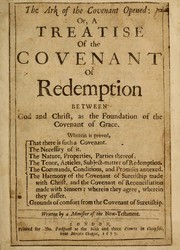
Signed, Sealed, Delivered: Patrick Gillespie’s The Ark of the Covenant Opened and the Eternal Bedrock of Your Peace

Have you ever had one of those days where your standing with God feels as shaky as a house of cards in a windstorm? For many of us, the spiritual life feels like an endless performance review. We wake up wondering if our “contract” with the Almighty is still valid or if a single bad day might trigger a cancellation clause. We treat grace like a fragile glass vase rather than the unshakeable rock it is intended to be.

In his classic work, The Ark of the Covenant Opened, 17th-century pastor Patrick Gillespie invites us to look behind the curtain of time into what theologians call the “Covenant of Redemption.” This isn’t just dry theory; it is the bedrock of our peace. Gillespie argues that our salvation isn’t a reaction to our choices, but the result of an eternal, iron-clad agreement between God the Father and God the Son.

As a pastor who holds to the Westminster Standards, I find Gillespie’s deep dive into this eternal arrangement to be exactly what our anxious age requires. Here are the most impactful takeaways from this massive treasury of truth.

The Foundation is Built on Christ’s Performance, Not Yours

Gillespie points out that the “Covenant of Grace” we enjoy today is like a beautiful skyscraper sitting on a foundation deep underground. He explains that this agreement “springs out of the Covenant made with Christ” before the world began. In this eternal pact, the Father and Son “plotted, consulted, and concluded” the business of our rescue long before we were even born.

This perspective shifts the focus from our fluctuating feelings to the steady, eternal will of God. Your security is settled because it rests on God’s deal with His Son, not on your ability to keep a promise.

“As the Covenant of Grace hath its rise from God only, and from Grace; so ’tis founded and bottomed upon nothing in us, but upon God’s Covenant with Christ.”

Jesus is a “Cautioner” Who Settles the Debt in Full

Gillespie uses a legal term that is incredibly powerful for a guilty conscience: the Surety, or “Cautioner.” Think of it as a co-signer on a loan you could never possibly repay. He explains that Jesus did not merely offer to help us pay our debt of sin; He legally stepped into our shoes in the courtroom of God. By becoming our Surety, Christ took on our “Law-place,” meaning your debt became His entire responsibility.

In divine justice, the Law cannot demand payment from both the Surety and the original debtor. Once Christ paid the price on the cross, the believer was legally cleared. Our debt isn’t just ignored; it is settled in full by a party who is “mighty to save.”

A Commissioned Ambassador, Not a Rogue Volunteer

One of Gillespie’s most insightful points is that Jesus did not “intrude” into the office of Savior on a whim. He was “called,” “designed,” and “sealed” for this specific task by the Father. Gillespie argues that this official commission gives the work of Jesus an unshakeable weight. Jesus is the “Messenger of the Covenant,” a high-level Ambassador sent with an official report from the Court of Heaven.

This matters because it proves the Father is just as invested in our rescue as the Son is. When we hear the Gospel, we aren’t hearing a sales pitch; we are receiving a formal report from a Messenger who was “fore-ordained before the foundation of the world.”

Even the Angels are Getting a Boost

In a surprising twist, Gillespie suggests that even the “good” Angels who never sinned benefit from Christ’s work. While they don’t need “redemption” from sin, they find their stability and “confirmation” in Christ.

This reminds us that Jesus is the center of the entire universe, not just a private “life coach” for humans. He is the “Head of all Principality and Power.” When we join the Covenant of Grace, we are joining a cosmic community where even the Angels look on with wonder, learning more about God’s wisdom through His dealings with us.

Christ is the Jewel, Not Just the Setting

Perhaps Gillespie’s most profound takeaway is the claim that Christ is called “the Covenant itself.” He is the summary and the “full price of the whole bargain.” Gillespie suggests that we often seek the benefits of the Covenant—like peace or pardon—while forgetting the Person who embodies them.

Christ is the “precious stone” in the ring, and all other blessings are merely the garnish. Because He is “all the Covenant,” having Christ means you have the entire contract, including every clause, every promise, and every future blessing.

“Christ is the jewel and precious stone of that ring; he himself is the chief thing that is in the Covenant.”


Why You Should Read This Book

In an era where everything feels temporary, Patrick Gillespie’s The Ark of the Covenant Opened provides an anchor that reaches back into eternity. This book is a masterclass in what theologians call “objective security.” It leads the reader out of the labyrinth of self-examination and into the sunlight of God’s settled purpose.

Gillespie helps the reader realize that they are not just a “saved sinner” trying to keep their head above water. Instead, they are a “Legatee”—someone who has been left a massive inheritance in a Will (the New Testament) that was signed in blood and proven in the highest court of the universe. Reading this book will help you stop treating your salvation like a trial period and start treating it like the settled legacy it is.

Final Thought to Ponder: If your salvation was a contract signed between the Father and the Son before time began, what possible mistake could you make today that is big enough to break it?

Christ’s Prayer Before His Passion by Anthony Burgess

Anthony Burgess’ Christ’s Prayer Before His Passion is an extensive and meticulous exposition of John 17, a chapter often referred to as the High Priestly Prayer. In this two-volume work, Burgess, a 17th-century Puritan minister, unpacks the depth and significance of Christ’s intercessory prayer with the precision and theological depth characteristic of Puritan exegesis. The sermons cover the entirety of John 17, focusing on the doctrinal, practical, and devotional aspects of the text, and are deeply rooted in the Puritan tradition, emphasizing the centrality of Christ’s mediatorial work.

The first volume of Burgess’ expository work primarily addresses the initial sections of John 17, where Christ prays for Himself and His glorification. Burgess methodically explains the significance of Christ’s requests, relating them to the larger framework of God’s redemptive plan. He delves into the nature of Christ’s glory, His relationship with the Father, and the implications of His finished work on the cross. The second volume shifts focus to Christ’s prayers for His disciples and the broader church, emphasizing the themes of unity, sanctification, and preservation in the truth. Burgess meticulously applies these themes to the life of the believer and the corporate life of the church, illustrating how Christ’s intercession is foundational for Christian life and practice.

Throughout these volumes, Burgess emphasizes the practical implications of Christ’s prayer, offering detailed applications for personal piety, church unity, and the believer’s relationship with the world. His expository method not only unpacks the theological richness of the text but also challenges readers to live in the light of Christ’s intercession. Burgess’ work is a blend of rigorous doctrinal teaching and heartfelt pastoral concern, in other words, a very typical curtain set of sermons, making it a valuable resource for both theological study and spiritual growth.

Burgess’ credentials as a theologian and pastor are evident in his writings, which are characterized by their depth of scriptural understanding and practical application. His ability to connect theological truths with everyday Christian living is a hallmark of his work, and Christ’s Prayer Before His Passion is no exception. As a member of the Westminster Assembly, Burgess’ insights into the nature of Christ’s mediatorial work are deeply informed by the Reformed tradition, making his expositions particularly valuable for those who hold to the Westminster Standards.

In conclusion, Christ’s Prayer Before His Passion by Anthony Burgess is a rich and invaluable resource for anyone seeking to understand the depths of Christ’s intercessory work. Burgess’ thorough exegesis, combined with his pastoral sensitivity, makes this two-volume set an essential tool for both pastors and laymen. Whether used for personal study, teaching, or devotional reading, this work offers timeless insights into one of the most significant passages in the New Testament.


“I received Christ’s Prayer Before His Passion by Reformation Heritage for the purpose of an unbiased review. I have not received any compensation for providing a positive review. My opinions are entirely my own and reflect my sincere evaluation of the book.”

Book Details:

  • Title: Christ’s Prayer Before His Passion: Expository Sermons on John 17
  • Author: Anthony Burgess
  • Publisher: Reformation Heritage Books

A Christian Directory by Richard Baxter

Richard Baxter’s “A Christian Directory,” published by Soli Deo Gloria Publications, stands as a monumental work in the realm of practical theology. The directory serves as a comprehensive guide for Christian living, addressing a wide range of topics from personal piety to family life and social ethics. Its aim is to provide Christians with a detailed roadmap for living out their faith in every aspect of life, grounded firmly in biblical principles and the rich tradition of Reformed theology.

One of the key strengths of Baxter’s work is its thorough treatment of personal spiritual disciplines. Baxter delves into the importance of regular prayer, meditation on Scripture, and self-examination, offering practical advice on how to cultivate these habits. For instance, he emphasizes the necessity of daily devotions, stating, “It is not enough to perform duties, but we must bring our hearts to them” (p. 123). This highlights the importance of engaging the heart in spiritual practices, not merely going through the motions.

In addition to personal piety, Baxter addresses the dynamics of family life with great detail and care. He provides guidance for marital relationships, child-rearing, and household management, all under the authority of Scripture. Baxter insists that the family is a microcosm of the church and society, and as such, it must be governed by biblical principles. He writes, “A well-ordered family is the best means for the reformation and peace of the church and state” (p. 342). This underscores the belief that strong families contribute to the overall health of the church and society.

Baxter also extends his discussion to social ethics and civic responsibilities. He encourages Christians to engage in their communities with integrity and love, advocating for justice and mercy in all interactions. He asserts, “Christianity is not a solitary religion but a social one, and it is our duty to promote the good of others” (p. 567). This reinforces the idea that faith should influence not only personal and family life but also public conduct and social engagement.

Richard Baxter was a 17th-century Puritan pastor and theologian known for his prolific writing and practical approach to Christian living. His ministry in Kidderminster, England, was marked by a deep commitment to pastoral care and an emphasis on practical godliness. Baxter’s credentials as a theologian and pastor lend significant weight to “A Christian Directory.” His extensive experience in ministry and his theological acumen are evident throughout the book, making it a valuable resource for both pastors and laypeople.

Compared to other works in the same genre, “A Christian Directory” is notably comprehensive and detailed. While contemporary books on Christian living, offer practical advice, they often lack the theological depth and historical context that Baxter provides. Similarly, “Knowing God” by J.I. Packer, while rich in theology, does not offer the same breadth of practical application found in Baxter’s directory. Baxter’s work stands out for its integration of robust theological insight with practical, everyday advice for living out the Christian faith.

The content of “A Christian Directory” is immensely helpful for understanding God’s Word and applying it to various aspects of life. Baxter’s use of Scripture is thorough and meticulous, providing a solid biblical foundation for his advice. He frequently cites and expounds upon biblical texts, ensuring that his guidance is firmly rooted in God’s Word. This makes the book not only a practical guide but also a rich source of biblical teaching.

For pastors, “A Christian Directory” is an invaluable tool. It offers a wealth of material for sermon preparation, pastoral counseling, and teaching. The detailed sections on personal and family piety, as well as social ethics, provide pastors with a comprehensive resource to address the diverse needs of their congregations. Baxter’s insights into pastoral care and church leadership are particularly beneficial for those in ministry.

Laypeople will also find Baxter’s work highly practical. The book’s clear and accessible writing style makes it easy to understand and apply the principles discussed. Whether dealing with personal spiritual growth, family dynamics, or social interactions, readers will find practical advice that is both theologically sound and applicable to everyday life.

The book’s cover and binding reflect its scholarly and practical nature. The sturdy hardcover ensures durability, making it suitable for frequent use and reference. The design is professional and understated, befitting a work of serious theological and practical import.

In conjunction with other works, “A Christian Directory” can be used to provide a well-rounded approach to Christian living. Paired with more contemporary books on Christian spirituality, it offers a historical and theological depth that enriches modern perspectives. Additionally, Baxter’s directory can complement systematic theological works, providing practical applications of doctrinal truths.

In conclusion, Richard Baxter’s “A Christian Directory” is a comprehensive and invaluable resource for Christians seeking to live out their faith in every aspect of life. Its detailed treatment of personal piety, family life, and social ethics, combined with Baxter’s robust use of Scripture and practical wisdom, make it a timeless guide for both pastors and laypeople. The book’s integration of theology and practice ensures that it remains relevant and useful for contemporary readers.

I have not received any compensation for providing a positive review. My opinions are entirely my own and reflect my sincere evaluation of the book.”

Book Details:

Title: A Christian Directory
Author: Richard Baxter
Publisher: Soli Deo Gloria Publications

The Art of Man-Fishing by Thomas Boston

Thomas Boston’s “The Art of Man-Fishing,” presents a compelling treatise on the art of evangelism, drawing upon the metaphor of fishing for men as outlined in the New Testament. Boston organizes his work into three main sections: the biblical foundation for evangelism, the practical aspects of evangelistic ministry, and the personal qualifications of an evangelist. Each section provides a thorough examination of its topic, offering both theological depth and practical application for those involved in gospel ministry.

In the first section, Boston establishes the biblical foundation for evangelism, focusing on Christ’s command to His disciples to be “fishers of men.” He delves into the scriptural basis for evangelism, emphasizing the Great Commission and the example of the apostles. Boston meticulously analyzes relevant passages, providing readers with a robust theological framework for understanding the necessity and urgency of evangelism in the Christian life.

The second section addresses the practical aspects of evangelistic ministry. Boston offers detailed guidance on how to effectively communicate the gospel message, adapt one’s approach to different audiences, and overcome common obstacles in evangelism. He includes practical advice on preaching, personal witnessing, and the use of various evangelistic tools. Boston’s insights are grounded in his own extensive experience as a pastor and evangelist, making his advice both realistic and actionable.

The final section explores the personal qualifications of an evangelist, emphasizing the importance of personal holiness, spiritual discernment, and a deep love for souls. Boston discusses the character traits and spiritual disciplines necessary for effective evangelistic ministry, highlighting the need for a close walk with God and a fervent prayer life. He also addresses the challenges and temptations that evangelists may face, offering biblical counsel for maintaining integrity and perseverance in ministry.

Thomas Boston was a noted Scottish Presbyterian minister and theologian in the early 18th century, renowned for his deep piety, theological acumen, and pastoral wisdom. His works, including “The Art of Man-Fishing,” have been influential in Reformed circles for their clarity, doctrinal soundness, and practical application. Boston’s academic background and extensive pastoral experience lend significant weight to his insights, making his writings a valuable resource for those seeking to grow in their understanding of Christian ministry.

When comparing “The Art of Man-Fishing” to other works on evangelism, such as “The Soul Winner” by Charles Spurgeon or “Evangelism and the Sovereignty of God” by J.I. Packer, Boston’s book stands out for its focus on the personal qualifications and spiritual disciplines of the evangelist. Spurgeon’s work offers passionate exhortations and practical advice, while Packer’s book addresses the theological tensions between divine sovereignty and human responsibility in evangelism. Boston’s contribution lies in his comprehensive treatment of both the theological foundations and the practical outworking of evangelistic ministry, with a strong emphasis on the personal holiness of the evangelist.

The content of “The Art of Man-Fishing” is immensely helpful for understanding God’s Word and applying it to the practice of evangelism. Boston’s thorough exegesis of key biblical passages provides a solid foundation for his teachings, ensuring that his advice is firmly rooted in Scripture. His practical insights help readers translate theological principles into concrete actions, making the book a valuable tool for anyone involved in gospel ministry.

For pastors, Boston’s book is a valuable resource for personal development and ministry practice. Its thorough treatment of evangelism provides a reliable guide for navigating the challenges of gospel ministry, from preaching and personal witnessing to addressing the spiritual needs of the congregation. Boston’s practical advice on maintaining personal holiness and spiritual vitality is particularly useful for those in pastoral roles.

Laypeople will also find “The Art of Man-Fishing” beneficial, especially those involved in evangelistic efforts or considering a call to ministry. Its straightforward language and practical insights make it accessible to a broad audience, and the inclusion of practical exercises and reflective questions enhances its usability for individual or group study. Lay leaders can gain a deeper understanding of evangelistic principles and how to effectively share their faith with others.

The book’s cover and binding are professional and durable, reflecting the quality of its content. The layout is user-friendly, with clear headings, subheadings, and occasional illustrations to enhance readability and usability. This design makes it easy for readers to navigate the book and find relevant sections quickly.

“The Art of Man-Fishing” can be effectively used alongside other works, such as study Bibles or devotional guides. Its theological depth and practical advice make it a valuable companion to other resources aimed at fostering spiritual growth and effective ministry. By providing a comprehensive understanding of evangelism, Boston’s book helps readers integrate this essential aspect of Christian discipleship into their broader understanding of the Christian life.

In conclusion, Thomas Boston’s “The Art of Man-Fishing” is an invaluable resource for both new and seasoned evangelists. Its blend of theological depth, biblical fidelity, and practical guidance makes it an essential read for anyone seeking to grow in their evangelistic abilities and serve their congregations faithfully. Boston’s clear exposition and commitment to Scripture provide a reliable guide for understanding and applying the principles of evangelism in the life of the church.

I have not received any compensation for providing a positive review. My opinions are entirely my own and reflect my sincere evaluation of the book.”

Book Details:

  • Title: The Art of Man-Fishing
  • Author: Thomas Boston

Human Nature in Its Fourfold State by Thomas Boston

Thomas Boston’s “Human Nature in Its Fourfold State,” is a seminal work of Reformed theology that systematically examines the human condition from a biblical perspective. The book is divided into four main sections: the state of innocence, the state of nature, the state of grace, and the state of glory. Each section meticulously explores the different aspects of human nature and its transformation through the work of Christ, providing a comprehensive theological framework for understanding the Christian doctrine of salvation.

In the first section, Boston addresses the state of innocence, delving into the nature of humanity as created by God, perfect and unblemished, in the Garden of Eden. He explores the original righteousness and holiness of Adam and Eve, the nature of their covenant with God, and the catastrophic impact of their fall into sin. This section sets the stage for understanding the subsequent states by highlighting the stark contrast between humanity’s original perfection and its fallen condition.

The second section examines the state of nature, focusing on humanity’s condition after the fall. Boston provides a detailed exposition of the total depravity and inherent sinfulness of all people apart from Christ. He explores the various dimensions of human corruption, including the mind, will, affections, and conscience. This section is crucial for understanding the depth of human need for redemption and the pervasive effects of sin on every aspect of human existence.

The third and fourth sections transition to the state of grace and the state of glory, respectively. In the state of grace, Boston outlines the process of salvation, from effectual calling and regeneration to justification, sanctification, and perseverance. He emphasizes the transformative power of the Holy Spirit in renewing and restoring fallen humanity. The final section, the state of glory, provides a vivid depiction of the ultimate consummation of salvation, where believers are fully conformed to the image of Christ and enjoy eternal communion with God.

Thomas Boston (1676-1732) was a prominent Scottish Presbyterian minister and theologian, known for his deep piety, rigorous scholarship, and pastoral sensitivity. His works, including “The Art of Man-Fishing” and “The Crook in the Lot,” have been influential in Reformed circles for their clarity, doctrinal soundness, and practical application. Boston’s extensive pastoral experience and theological acumen are evident throughout “Human Nature in Its Fourfold State,” making it a valuable resource for both academic study and personal edification.

When comparing “Human Nature in Its Fourfold State” to other works on the human condition and salvation, such as Augustine’s “Confessions” or John Calvin’s “Institutes of the Christian Religion,” Boston’s book stands out for its structured approach and comprehensive treatment of the topic. Augustine’s work provides a personal and introspective account of his spiritual journey, while Calvin’s Institutes offer a systematic and doctrinal exposition of Reformed theology. Boston’s contribution lies in his ability to synthesize these elements, providing a detailed and accessible exploration of the human condition from a biblical and theological perspective.

The content of “Human Nature in Its Fourfold State” is immensely helpful for understanding God’s Word and applying it to one’s life. Boston’s thorough exegesis of key biblical passages ensures that his teachings are firmly rooted in Scripture. His practical insights help readers translate theological principles into concrete actions, making the book a valuable tool for personal spiritual growth and discipleship.

For pastors, Boston’s book is an invaluable resource for sermon preparation and pastoral counseling. Its thorough treatment of the human condition provides a reliable guide for addressing the spiritual needs of the congregation, from preaching on the nature of sin and salvation to offering counsel on personal sanctification. Boston’s practical advice on maintaining personal holiness and spiritual vitality is particularly useful for those in pastoral roles.

Laypeople will also find “Human Nature in Its Fourfold State” beneficial, especially those seeking to deepen their understanding of Reformed theology and its practical implications. The book’s straightforward language and practical insights make it accessible to a broad audience, and the inclusion of reflective questions and practical exercises enhances its usability for individual or group study. Lay leaders can gain a deeper understanding of the doctrine of salvation and how to effectively apply it in their daily lives.

The book’s cover and binding are professional and durable, reflecting the quality of its content. The layout is user-friendly, with clear headings, subheadings, and occasional illustrations to enhance readability and usability. This design makes it easy for readers to navigate the book and find relevant sections quickly.

“Human Nature in Its Fourfold State” can be effectively used alongside other works, such as study Bibles or devotional guides. Its theological depth and practical advice make it a valuable companion to other resources aimed at fostering spiritual growth and effective ministry. By providing a comprehensive understanding of the human condition and salvation, Boston’s book helps readers integrate these essential aspects of Christian discipleship into their broader understanding of the Christian life.

In conclusion, Thomas Boston’s “Human Nature in Its Fourfold State” is an invaluable resource for both new and seasoned believers. Its blend of theological depth, biblical fidelity, and practical guidance makes it an essential read for anyone seeking to grow in their understanding of the human condition and the doctrine of salvation. Boston’s clear exposition and commitment to Scripture provide a reliable guide for understanding and applying these doctrines in the life of the church.

I have not received any compensation for providing a positive review. My opinions are entirely my own and reflect my sincere evaluation of the book.”

Book Details:

  • Title: Human Nature in Its Fourfold State
  • Author: Thomas Boston
« Older posts Newer posts »

© 2026 The Puritan Reader

Theme by Anders NorenUp ↑